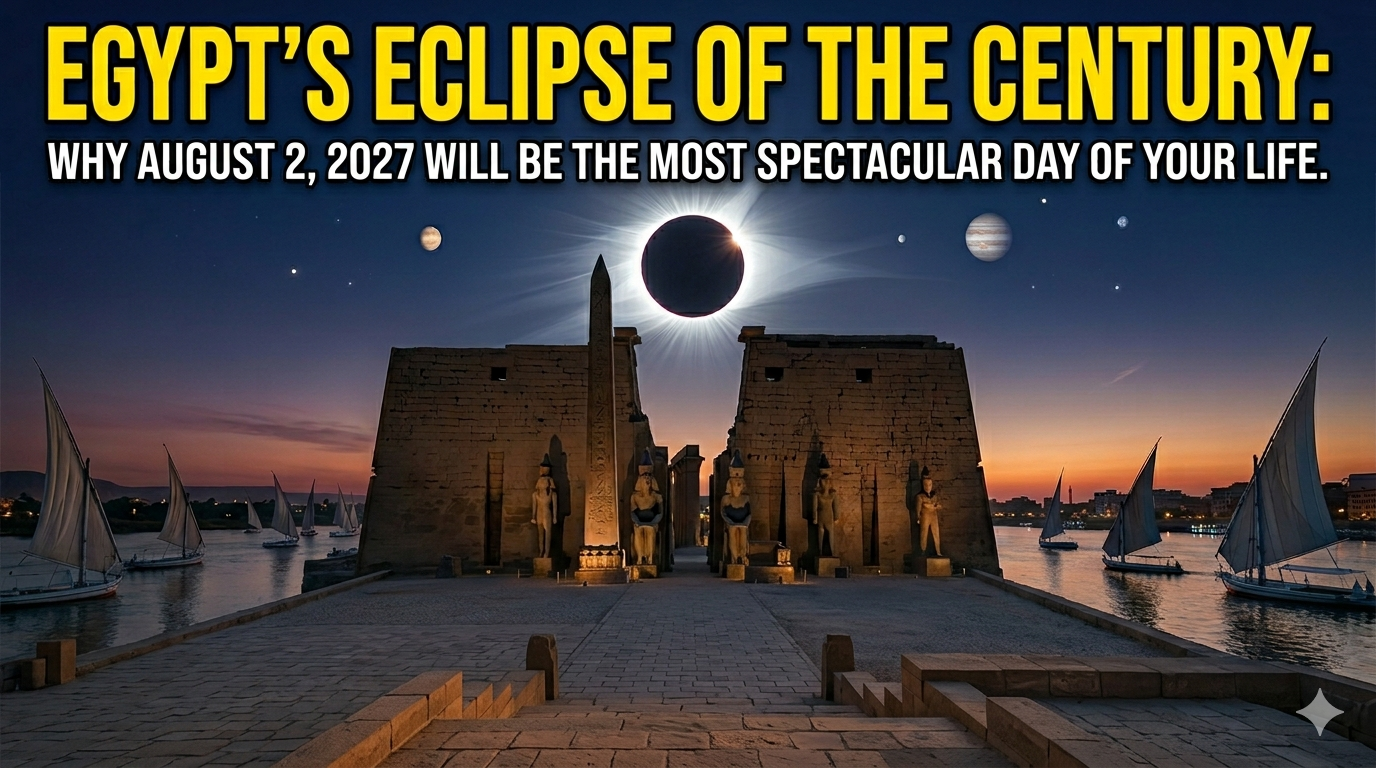
On the morning of August 2, 2027, the Moon will slide perfectly between Earth and the Sun, plunging a 200-kilometer-wide corridor across North Africa into sudden midday darkness. What makes this eclipse extraordinary is not just the spectacle itself, it's the sheer length of it. Totality will last a staggering 6 minutes and 23 seconds, making it the longest total solar eclipse on easily accessible land in the entire 21st century. The next comparable event won't occur until June 3, 2114.
To put that in perspective: most total solar eclipses offer 2–3 minutes of darkness. This one gives you more than double. Time enough to watch the solar corona bloom, spot stars at noon, feel the temperature drop, and hear the birds fall silent, twice over.
Why Egypt?
The path of totality passes almost directly over Luxor, the ancient city of Thebes. Astronomers have nicknamed this the "Eclipse of the Century," and it's expected to draw more tourists than any astronomical event in history, an estimated 89 million people live within the path of totality, more than double the 44 million who were in the path of the April 2024 North American eclipse.
What makes Egypt particularly ideal is the weather. The statistical probability of a completely cloud-free sky over Luxor and the surrounding desert in August is around 80–82%. That is a staggering forecast for such a once-in-a-generation event.
Eclipse Timeline (Cairo Time)
11:19 AM — Partial eclipse begins. The Moon first bites into the Sun's disk.
12:39 PM — Totality begins. The Sun disappears completely. Day becomes night. The solar corona blazes into view.
~12:45 PM — Maximum eclipse. The greatest duration of totality occurs over Egypt's New Valley Governorate.
1:22 PM — Totality ends. Sunlight rushes back. The partial eclipse continues.
2:39 PM — Partial eclipse ends. The event concludes near Hala'ib.
Best Viewing Spots
- Luxor (~6 min 20 sec totality), Home of Karnak and the Valley of the Kings. The prime blend of astronomy and antiquity. Standing in the Karnak complex as the moon's shadow races across the desert at over 2,000 km/h, plunging the Hypostyle Hall into darkness while stars appear above its ancient obelisks, will be among the most remarkable human experiences of the 21st century.
- Bahariya Oasis (~6 min 22 sec totality), Desert serenity far from city crowds, close enough to Cairo for a day trip. Perfect for photography with minimal light pollution.
- Red Sea Coast (up to 6 min 20 sec), Combine totality with world-class diving and snorkeling near Marsa Alam and Berenice.
- Nile Cruise, Watch totality glide over the water from a luxury river cruise between Luxor and Aswan, arguably the most atmospheric option of all.
Egypt's Ancient Skies Meet Modern Wonder
There is something profoundly moving about watching a solar eclipse from a land where humans have been studying the sky for over 5,000 years. The ancient Egyptians worshipped Ra, the sun god, with temples engineered to catch the first light of dawn. On August 2, 2027, Ra will vanish in broad daylight, right over the very temples built in his honor.
Essential Tips Before You Go
- Eye safety: Use ISO 12312-2 certified eclipse glasses during partial phases. Remove them only during totality, then put them back the moment the Sun reappears.
- Book now: Hotels across Luxor and the Red Sea coast are already selling out. Demand is expected to be the highest for any astronomical event in history.
- August heat: Temperatures in Luxor in August exceed 40°C. Seek shaded or air-conditioned viewing areas, bring water, and consider desert sites where you can set up in the cooler early morning hours.
Mark your calendar: August 2, 2027. Don't miss it.
News and EventsJanuary 29, 2026