On the evening of Saturday, 1 November 2025, the desert sky above Giza lit up with drones forming the golden mask of Tutankhamun, and the world held its breath. After more than three decades of dreaming, planning, construction, delays, and anticipation, the Grand Egyptian Museum — the GEM — finally opened its doors. It was not merely the opening of a building. It was a declaration: that Egypt's past belongs to the whole world, and that Egypt intends to share it on its own terms, in a setting worthy of the civilization it honors.
The GEM is now the largest museum in the world dedicated to a single civilization. It houses over 100,000 artefacts spanning some 7,000 years, from Egypt's prehistoric past through the Pharaonic era and into the Greco-Roman period. To put that in perspective: if a visitor spent just one minute with each artefact, it would take nearly 70 sleepless days to see them all. There is nothing else like it on earth.
Where the idea was born:
The story of the GEM begins in 1992, when Egyptian authorities first acknowledged what had long been obvious: the beloved but overcrowded Egyptian Museum in Cairo's Tahrir Square — opened in 1902 — could no longer do justice to Egypt's staggering archaeological wealth. The collection had outgrown the building by decades, with countless artefacts in storage, conservation standards under strain, and visitor numbers straining every corridor.
The idea took its first concrete form in 2002, when Egypt's Ministry of Culture launched what became the largest international architectural competition ever held for a completed cultural building. The call attracted over 1,550 submissions from firms in 83 countries — a number that itself speaks to how much the world cared about this project.
1992:
Egyptian authorities first propose a new museum to replace the overwhelmed Egyptian Museum in Tahrir Square.
2002:
International architectural competition launched — the largest of its kind ever held. Over 1,550 entries received from 83 countries.
2003:
Irish firm Heneghan Peng Architects announced as the winner. Design work begins immediately.
2005:
Construction begins on the Giza Plateau. Schematic design completed; Japan's JICA signs on as the principal international funding partner.
2006:
The 83-tonne colossal statue of Ramses II is relocated from Ramses Square in central Cairo to the GEM site in a 10-hour procession watched live across Egypt.
2016:
Major construction phases accelerate. German firm Atelier Brückner is commissioned to design the Tutankhamun Galleries.
2021:
Khufu's Solar Boat is transferred to the GEM. Artefact installation begins — a process expected to take months that stretches into years.
October 2024:
Trial opening: 4,000 visitors given an exclusive preview of the main galleries ahead of the official inauguration.
1 November 2025:
Official grand opening ceremony. 79 world delegations attend. The GEM opens fully to the public on 4 November 2025.
The investment: how it was funded:
The GEM's original cost estimate stood at around $500 million. The final bill exceeded $1 billion — more than double the initial projection. The project was financed through a combination of Egyptian state resources, an international fundraising campaign, and a landmark soft loan from Japan's International Cooperation Agency (JICA), which contributed approximately $392 million (34.8 billion Japanese Yen) to cover the bulk of Phase III construction, interior design, landscaping, and information technology systems. JICA also provided extensive technical assistance to the museum's conservation center, training Egyptian specialists in collaboration with the National Research Institute for Cultural Properties in Tokyo.
The scale of Japanese involvement in preserving Egypt's heritage is one of the lesser-known but most significant aspects of this project — a quiet act of cultural diplomacy that spanned nearly two decades.
The architect: Heneghan Peng:
-> Designed by Heneghan Peng Architects, a Dublin and Berlin-based firm founded in 1999 by Róisín Heneghan and Shih-Fu Peng — selected from over 1,550 international entries.
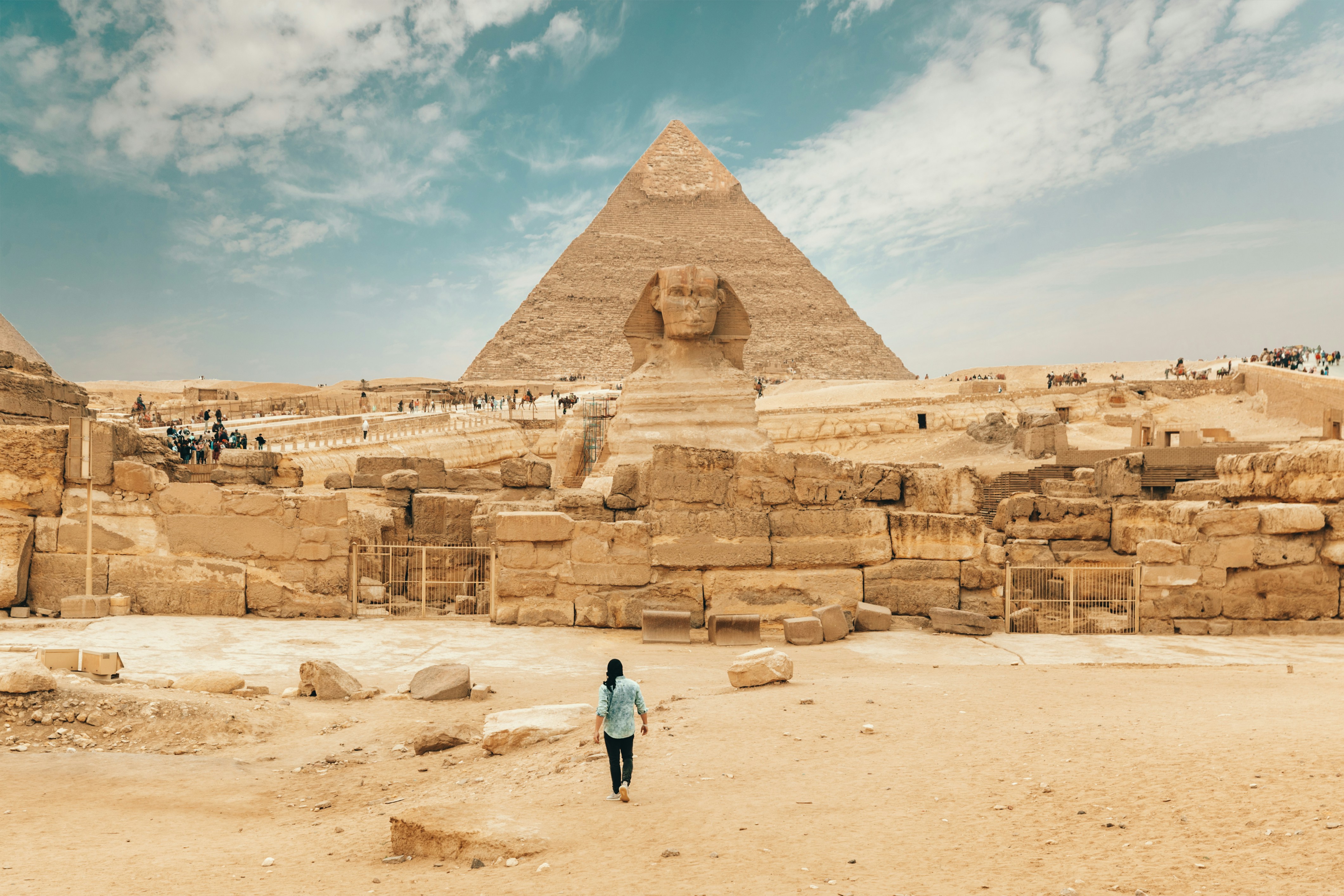
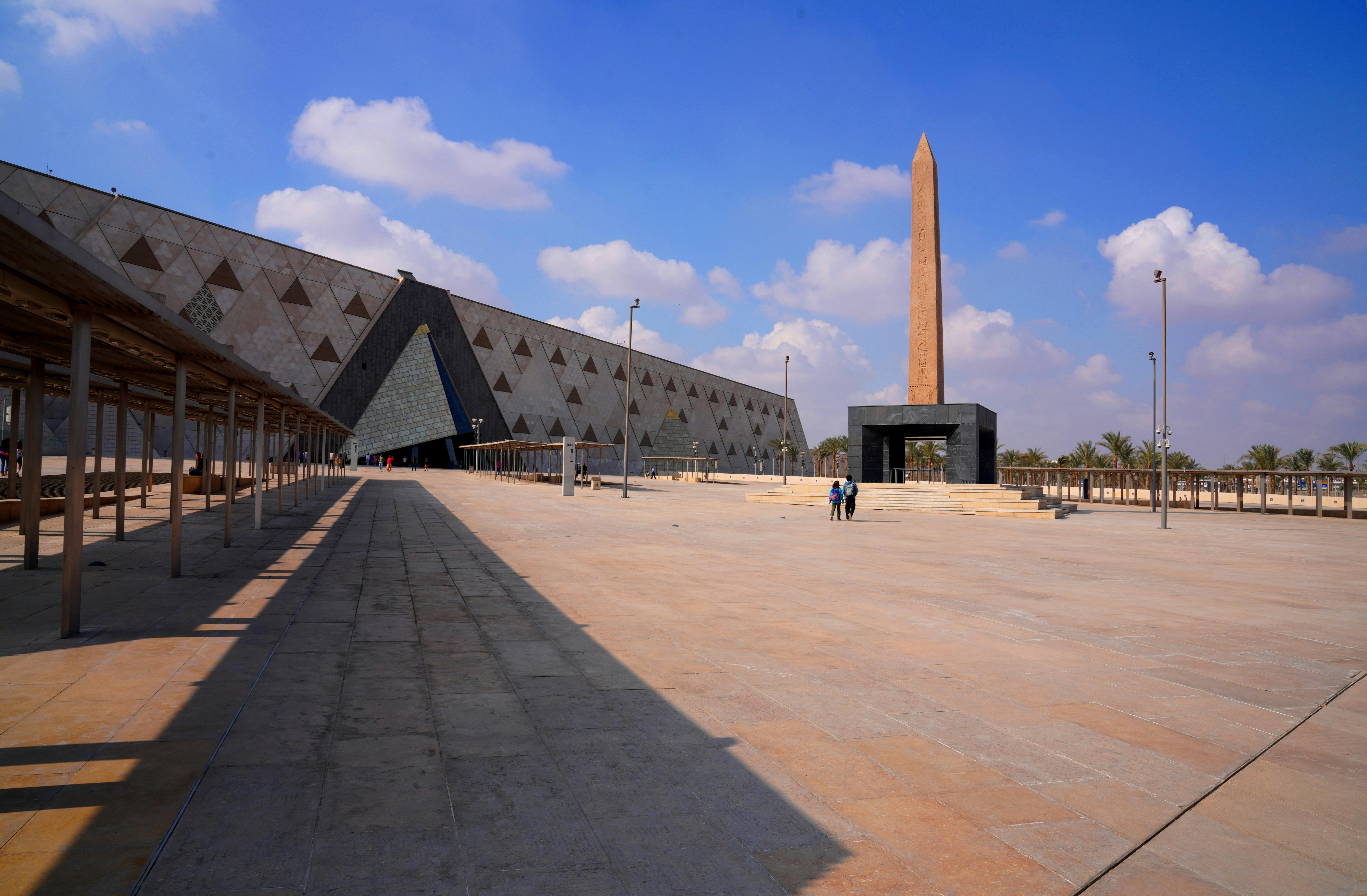
-> The building's triangular form fans outward from its entrance, with its five walls precisely aligned to point toward the three pyramids of Giza, -creating a visual axis between the ancient monuments and the modern museum.
-> The facade is clad in locally sourced Egyptian alabaster, which shifts in appearance between day and night, evoking the changing tones of the desert sands.
-> The building never exceeds the height of the pyramids — a deliberate act of architectural respect for its ancient neighbors.
-> A secondary design path running through the complex symbolizes the Nile's journey through the desert, threading natural and cultural history together.
-> Structural engineering by Arup; building services by BuroHappold Engineering; landscape by West 8; Tutankhamun Galleries interior design by Atelier Brückner (Germany).
-> 79 million cubic feet of sand were excavated to reshape the topography and open panoramic views of the pyramids from inside the museum.
The opening night: a ceremony like no other:
The inauguration ceremony on 1 November 2025 was a spectacle of history, culture, and national pride. Egyptian President Abdel Fattah El-Sisi presided over the event alongside First Lady Entissar El-Sisi, welcoming nearly 80 official world delegations — 39 of which were led by reigning monarchs, princes, and heads of state. The ceremony featured drone displays forming ancient Egyptian symbols above the Giza sky, a musical performance titled "King Ramses II," theatrical shows dedicated to the Solar Boat and Tutankhamun, and a Nile-themed spectacle celebrating Egypt's eternal relationship with its great river.
In a symbolic gesture, each visiting head of state and monarch was presented with a miniature replica of the GEM engraved with their country's name. President El-Sisi placed the final piece — representing Egypt — to officially declare the museum open.
Royals attending
Belgium, Spain, Denmark, Jordan, Bahrain, Oman, UAE, Saudi Arabia, Luxembourg, Monaco, Japan, Thailand
Prime Ministers
Greece, Hungary, Belgium, Netherlands, Kuwait, Lebanon, Luxembourg, Uganda
Ministerial delegations
UK, France, USA, Canada, China, India, Russia, Italy, Turkey, South Africa + 30 more nations
International organizations
Arab League, Organization of Islamic Cooperation, African Union Commission, UN Alliance of Civilizations
What's inside: the highlights:
-> Tutankhamun Galleries
Over 5,000 artefacts from the boy king's tomb — displayed together in their entirety for the first time since their discovery in 1922. Designed by Atelier Brückner.
-> Colossus of Ramses II
An 83-tonne, 3,200-year-old granite statue that greets visitors in the entrance courtyard. Relocated from central Cairo in 2006 in a celebrated 10-hour procession.
-> Khufu Solar Boat
A fully reassembled 4,500-year-old cedar boat, 43.6 metres long, built for Pharaoh Khufu's journey to the afterlife. Transferred to the GEM in 2021.
-> The Hanging Obelisk
A 3,500-year-old obelisk, 53 feet high, suspended on a modern structure with a glass floor — the only such installation in the world.
-> The Grand Staircase
108 steps rising the equivalent of six floors, lined with colossal royal statues, leading visitors upward toward the main galleries and panoramic pyramid views.
-> Conservation Centre
One of the world's largest conservation facilities, with 17 specialist laboratories — connected to the main building by tunnel — actively preserving Egypt's heritage.
Watch the opening:
The full ceremony and official video of the GEM's opening are available on YouTube. Here are the key links:
Official GEM Opening — YouTube
All videos available to watch free
[1] The Grand Opening of the Grand Egyptian Museum — Official Trailer
Grand Egyptian Museum Official Channel · Oct 28, 2025
youtube.com/watch?v=g1mAmNozMJM
[2] Official Full HD Video of the Grand Egyptian Museum Opening Ceremony
CairoScene (official exclusive release) · Nov 8, 2025
youtube.com/watch?v=jMdd6i9RPsU
[3] Grand Egyptian Museum — Live Opening Ceremony from Giza
Live broadcast from November 1, 2025
youtube.com/watch?v=bc1yl-AJ_D0
What the GEM means for Egypt:
The opening of the GEM arrives at a moment of significant economic significance for Egypt's tourism industry. In the first nine months of 2025 alone, Egypt welcomed 15 million visitors, generating $12.5 billion — a 21 percent increase year-on-year. Egypt's tourism minister has projected that total arrivals will reach 18 million by year's end, and that the GEM alone could draw 5 million visitors annually, eventually scaling to 15,000 visitors per day.
The GEM is also more than a museum in the traditional sense. The complex includes a conference centre, research library, educational facilities, a dedicated children's museum, landscaped gardens covering 120,000 square metres, and a pedestrian walkway connecting the museum directly to the Pyramids of Giza — meaning visitors can now walk between the ancient monuments and their new home under one continuous cultural journey.
The opening has also reignited long-standing conversations about the repatriation of Egyptian artefacts held abroad. The Rosetta Stone remains in the British Museum, the Dendera Zodiac in the Louvre, and Nefertiti's bust in Berlin's Neues Museum. With the GEM now open and fully equipped to house and conserve them, Egyptologists and Egyptian citizens have renewed calls for their return — and for the first time, Egypt has a facility that arguably makes that argument stronger than ever.
"The Grand Egyptian Museum is not just Egypt's greatest cultural project of the modern era — it is one of humanity's. It took 33 years to build, cost over a billion dollars, required the work of architects on three continents, and drew the leaders of 79 nations to its opening night. It now stands beside the pyramids that inspired it, not competing with them, but completing the story they began 4,500 years ago."
AttractionsNovember 4, 2025